Case Study FlyteHealth · Product & AI

FlyteHealth:
EMR-integrated care, engagement,
and AI at scale

A virtual cardiometabolic care platform combining patient experience design, recurring revenue infrastructure, and clinically grounded AI. I led key parts of the patient journey across onboarding, engagement, billing, and Ask FlyteHealth — an EMR-integrated assistant designed for real clinical use.

Role
Senior Director of Product, Patient Experience
Focus
Patient experience, recurring billing, EMR-connected workflows, clinical AI
Platform
Virtual obesity and chronic condition care
FlyteHealth platform overview diagram
FlyteHealth logs screen in iPhone mockup
Patient-facing logging and progress tracking inside the FlyteHealth mobile experience.
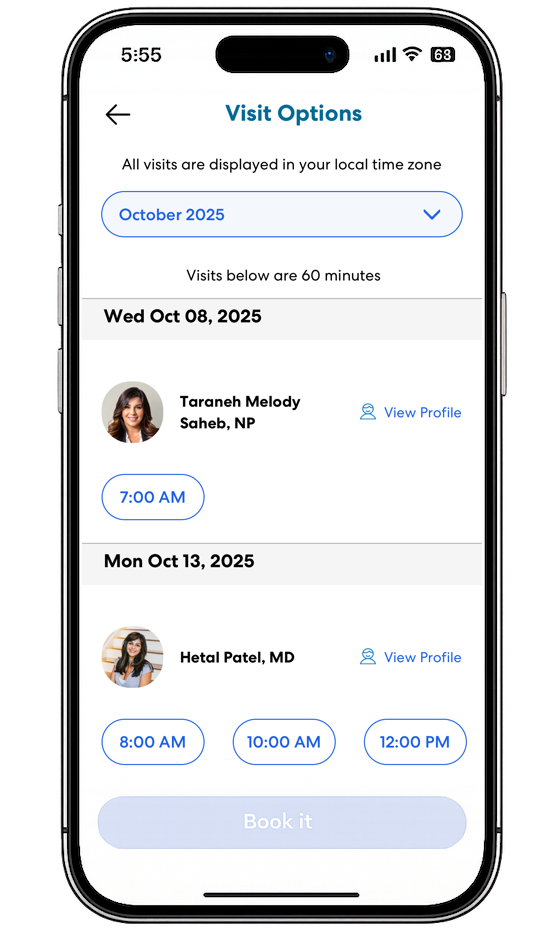
FlyteHealth self-scheduling screen in iPhone mockup
EMR-integrated self-scheduling with provider matching, enabling patients to book directly into their care team.
86%
Patient adherence
75
Patient NPS
13–16%
Average weight loss in 1 year
200+
Health conditions supported

Scaling a high-touch care model without losing trust

FlyteHealth sat at the intersection of consumer product expectations and real clinical complexity. Patients needed a clear, supportive experience. Care teams needed workflows that actually fit longitudinal care. The business needed a platform that could support recurring revenue and measurable outcomes.

The challenge was not simply building a better app. It was designing a connected system that could support onboarding, engagement, billing, and care guidance in a way that felt coherent to patients and operationally durable to the organization.

That same systems mindset shaped the AI work. In a clinical setting, generic chat behavior is not enough. Ask FlyteHealth had to be grounded in real patient context, constrained appropriately, and designed to earn trust rather than improvise through it.

01 / Conversion
Onboarding needed to reduce friction without hiding complexity
In regulated care, enrollment, scheduling, and payment expectations must be clear early. The work was to make those steps feel structured and trustworthy, not confusing or punitive.
02 / Retention
The product had to support patients between visits
Longitudinal care depends on sustained engagement. Messaging, coaching, reminders, and post-visit continuity had to feel like part of one care experience, not disconnected features.
03 / Revenue
Billing was part of the product experience
The monthly program fee model needed recurring payments, support for credit, debit, and FSA cards, and timing aligned to the care journey so the experience felt fair and predictable.
04 / AI Safety
Clinical AI had to be grounded, constrained, and reviewable
In this context, helpfulness alone was insufficient. AI needed retrieval grounding, structural validation, and explicit controls for how sensitive categories like medication-related responses were framed.

Three interconnected pillars of the FlyteHealth experience

Rather than treat engagement, billing, and AI as separate initiatives, the work was to make them reinforce one another inside a single patient and care-team experience.

Patient Experience
Care journeys that were operationally sound
Led product development across onboarding, self-scheduling, secure messaging, and the systems patients used to stay connected to care over time. The aim was not just usability, but continuity: each step had to make the next one easier.
Revenue Infrastructure
A recurring billing model designed into the experience
Led 0→1 development of the monthly program fee model, including recurring payments across credit, debit, and FSA cards. Billing was intentionally aligned with the care journey, starting after the first appointment to reduce early friction and complaints.
Clinical AI
Ask FlyteHealth from prototype to production
Led the productization of an EMR-integrated assistant supporting onboarding, nutrition coaching, exercise guidance, medication adherence, blood pressure monitoring, and post-visit guidance — with responses grounded in real patient and content context.

Clinical AI designed for a live care environment

Ask FlyteHealth was not positioned as a generic chatbot. It was built as an EMR-integrated patient support layer that could respond using chart context, longitudinal data, and curated content rather than broad, unbounded health advice.

The assistant supported use cases across onboarding, nutrition coaching, exercise guidance, medication adherence, blood pressure monitoring, and personalized care plan generation. That breadth made architecture and controls central to the product strategy.

The core product challenge was balancing usefulness with discipline: keeping responses specific enough to help, while ensuring the system stayed grounded in approved sources and appropriate framing.

Grounding
Strict retrieval grounding with no open-web fallback and no speculative response mode.
Validation
Structured output validation before patient delivery, rather than relying on the model alone.
Risk Controls
Medication-related responses constrained to factual, non-prescriptive framing where appropriate.
Iteration
Prompt changes supported by regression testing and SME-guided clinical review.
Ask FlyteHealth appointment summary interface
A patient-facing AI interaction grounded in prior appointment context rather than generic advice.

Real patient context

Responses were grounded in medications, vitals, provider instructions, longitudinal patient context, and curated clinical content — not just generic health knowledge.

Production orientation

The system was framed as a production capability, not a demo artifact: architecture, auditability, and safe iteration were treated as product requirements from the start.

A retrieval-grounded stack built for clinical context

The Ask FlyteHealth architecture pulled from three sources: the EMR, the FlyteHealth data lake, and a curated content library. Those inputs were routed through a retrieval-grounded generation pipeline designed to make patient-facing responses more specific and less fragile.

The point was not to showcase AI sophistication for its own sake. It was to build a system whose outputs could be reasoned about, improved safely, and deployed inside a real healthcare experience.

Orchestration Python · LangChain
Models Anthropic via AWS Bedrock
Retrieval FAISS knowledge base
Clinical Sources EMR · data lake · content library
Front Ends React · React Native
Security Posture HIPAA · HITRUST · PCI
Context Layer
EMR + Data + Content
Dynamic patient data, chart context, and curated content formed the evidence base for responses.
Generation Layer
Retrieval-Grounded Response Pipeline
Responses were generated against retrieved context rather than broad open-ended prompting.
Control Layer
Validation + Deterministic Enforcement
Selected categories used hard constraints and structure checks to reduce risky drift.
Experience Layer
Web and Mobile Patient Access
The assistant lived inside the product experience patients were already using, rather than as an isolated innovation demo.

What this case study demonstrates

Outcome Signals
The platform delivered measurable results

Available reported outcomes include 86% adherence, 75 NPS, 13–16% average weight loss in one year, 12% decrease in A1c, 6% decrease in LDL cholesterol, and support across 200+ health conditions.

Product Scope
The work cut across experience, operations, and revenue

This was not a narrow feature ownership story. It reflects end-to-end product leadership across patient workflows, payment architecture, and the emerging AI layer inside a healthcare platform.

AI Credibility
The AI work was production-oriented and clinically grounded

Ask FlyteHealth shows experience moving beyond generic AI claims toward grounded productization: architecture choices, risk controls, review processes, and a clear relationship to the underlying care model.

Key takeaways

Healthcare UX

Compliance is a design material

The best healthcare experiences do not avoid operational and regulatory complexity. They absorb it and turn it into clarity for patients.

Business Systems

Billing shapes trust earlier than most teams admit

Recurring revenue systems are not back-office details. In care delivery, they are part of the emotional and practical first impression of the product.

Clinical AI

Grounded AI is a product discipline

Reliable healthcare AI depends on retrieval, validation, and explicit constraints — not on hoping the model behaves. Product strategy has to include those controls from the beginning.